
Criminal Defense Lawyer In Beaumont, TX
A criminal case in Jefferson County runs through a single courthouse in Beaumont, whether the arrest happened in Port Arthur, Nederland, Groves or on the highway. This page explains the path from arrest to appeal, what each level of charge carries, and where to find each practice area.
How Does A Criminal Case Work In Jefferson County?
A criminal case starts with an arrest by a city, county or state agency, booking into the county jail system and a magistrate hearing within 48 hours. Misdemeanors are filed in a County Court at Law. Felonies go to a grand jury and a district court. All of these courts are in one courthouse on Pearl Street.
Source: Texas Code of Criminal Procedure Chapter 15, Arrest Under Warrant
Understanding The System
How Does A Criminal Case Move Through Jefferson County?
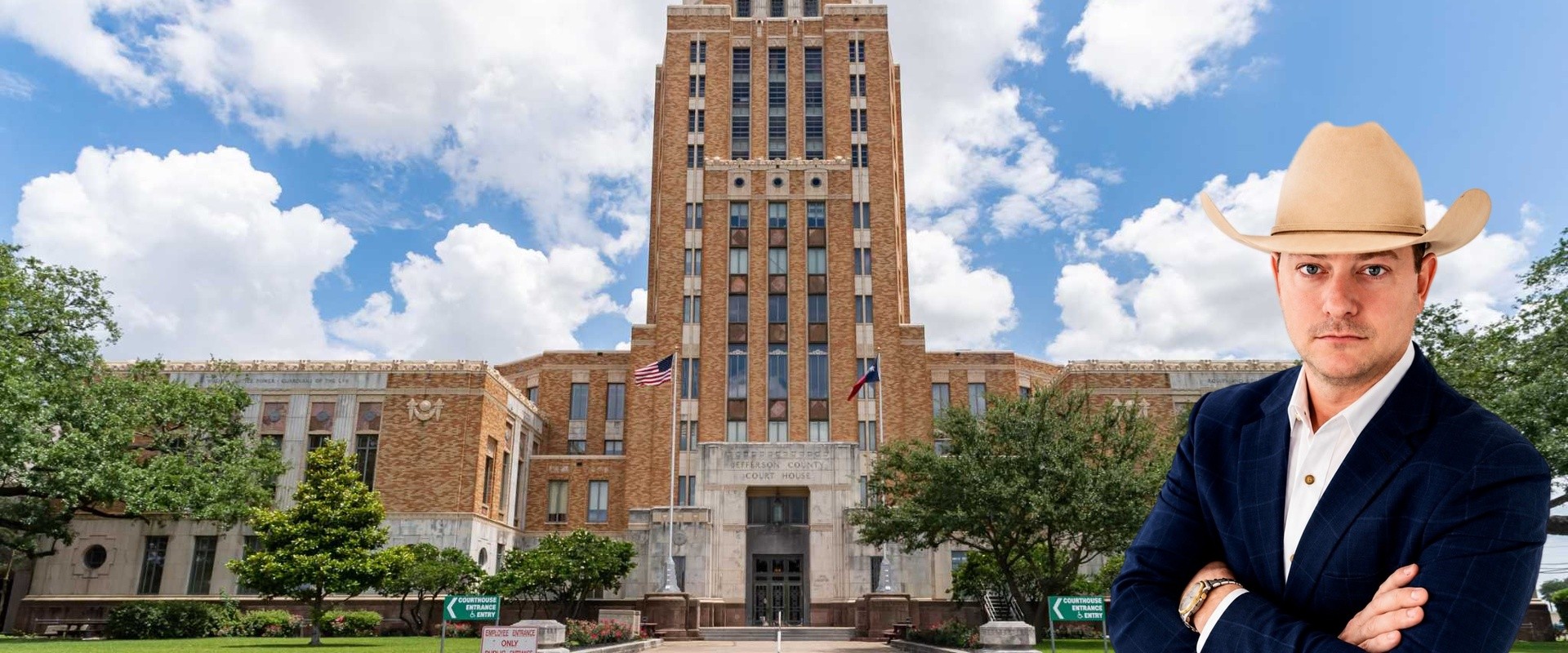
Arrests in Jefferson County happen in many different jurisdictions, but the case file ends up in one place. The Jefferson County Courthouse at 1085 Pearl Street holds the courts, the District Clerk, the County Clerk's court division and the Jefferson County Criminal District Attorney's Office.
That layout shortens the map. The court, the clerk and the prosecutor share an address, which is not true in every Texas county.
Mitchell Law Firm has no office in Beaumont. The firm serves Jefferson County from its Orange office.
The first two days after an arrest follow the same path, whoever made it:
- An arrest by one of the Beaumont Police Department, Jefferson County Sheriff's Office, Texas DPS Highway Patrol, Port Arthur Police Department, Nederland Police Department, Port Neches Police Department, or Groves Police Department
- Booking into the county's jail system
- A magistrate hearing within 48 hours, where the charge is explained and bail is set
- Filing as a misdemeanor, or presentment to a grand jury for a felony
Where Each Case Is Heard
Which Court Hears Which Charge In Jefferson County?
Texas grades every offense into a class or degree, and the grade sets both the punishment range and the court. The ranges below are the general ones in Penal Code Chapter 12. A prior conviction or another added fact can move a charge up a level. These are statutory limits, not predictions.
No jail.
Up to a $2,000 fine.
Up to a $4,000 fine.
Or life.
- Class C misdemeanor
- A fine of up to $500 and no jail. Handled in a municipal or justice court.
- Class B misdemeanor
- Up to 180 days in county jail and a fine of up to $2,000. Filed in one of the Jefferson County Courts at Law.
- Class A misdemeanor
- Up to one year in county jail and a fine of up to $4,000. Filed in one of the Jefferson County Courts at Law.
- State jail felony
- 180 days to two years in a state jail facility and a fine of up to $10,000. Presented to a grand jury, then heard in the district courts at the Jefferson County Courthouse on 1085 Pearl Street.
- Third, second and first degree felonies
- Two to ten years, two to twenty years, and five to ninety-nine years or life, each with a fine of up to $10,000. Heard in the district courts at the Jefferson County Courthouse on 1085 Pearl Street.
- Towns in the county
- Port Arthur, Nederland, Port Neches, Groves, Nome, China, Bevil Oaks, Fannett, and Hamshire.
- Who prosecutes
- Felonies are prosecuted by the Jefferson County Criminal District Attorney's Office. Misdemeanors in the county courts are handled by prosecutors in Jefferson County.
- Driver's license
- A separate ALR case before the State Office of Administrative Hearings, with the hearing request due 15 days after the notice of suspension is received.
- State appeals
- Appeals go to the Ninth Court of Appeals in Beaumont.
- Federal charges
- Filed in the United States District Court for the Eastern District of Texas, Beaumont Division, with appeals to the Fifth Circuit Court of Appeals.
A charge can change between arrest and filing. The offense on a booking sheet is the officer's description, and the charge in the complaint, information or indictment is the prosecutor's. The two do not have to match, and the filed charge is the one the court hears.
Real Questions
What Do People Ask About Criminal Charges In Texas?
Which practice areas does this site cover?
Is probation the same as deferred adjudication?
What are 3G offenses?
Can a record be cleared after a case ends?
Is there a time limit for the state to file charges?
Building A Defense
How Is A Criminal Defense Built In Texas?
A defense starts with the state's file. An attorney requests the evidence, watches the video, reads the reports and compares them with what the statute requires. Each charge has its own elements and its own weak points. No result can be promised.
The tools the law gives a defendant, from suppression motions to challenges to lab work, are collected on the defense strategies page.
Five questions apply to almost every case.
- Was the stop, search or arrest lawful?
- Does the evidence prove each element of the charge?
- Were statements taken after proper warnings?
- Is the filed charge the one the facts support?
- What would each possible outcome mean for the record?
Short answers on bond, settings and timing are on the criminal defense FAQ page.

The Stop And Search
Did officers have a lawful reason for each step of the encounter?
The Evidence
What do the recordings, reports and lab records actually show?
The Filed Charge
Does the level the prosecutor chose fit the facts?
The Options
Would dismissal, reduction, deferred adjudication, diversion or trial fit?
The Clocks
Which deadlines are running, such as a license hearing request?
The Record
What will an outcome mean for work, housing and licenses?
Local Process
What Happens After An Arrest In Jefferson County?
The steps below follow Texas law statewide. Where a case is filed, who prosecutes it and where an appeal goes are the parts specific to Jefferson County.
Arrest And Booking
An agency makes the arrest and the person is booked. A magistrate gives the statutory warnings and sets bail within 48 hours.
Charging
A misdemeanor proceeds on a complaint and information. A felony goes to a grand jury, which decides whether to indict.
Evidence And Motions
The defense asks for the state's evidence and files motions about the stop, the search or the statements.
Resolution
The case ends in a dismissal, a plea with or without supervision, or a trial.
- Where misdemeanors are filed
- one of the Jefferson County Courts at Law.
- Where felonies are heard
- the district courts at the Jefferson County Courthouse on 1085 Pearl Street, after a grand jury indictment.
- Courthouse
- The Jefferson County Courthouse at 1085 Pearl Street.
- If the case is appealed
- the Ninth Court of Appeals in Beaumont.
The DWI defense page covers the most common charge in the county. The felony DWI page covers what changes when a DWI reaches the district courts. A federal case is a separate system with its own prosecutors. The Beaumont Division sits in the same city as the county courthouse.
Next Steps
What Should You Do After A Criminal Charge?
These steps are general information, not advice for any one person.
Find The Charge
Read the booking sheet, citation or complaint to see the offense and its level.
List Every Deadline
Court dates, bond conditions and license deadlines each run on their own clock.
Say Little About The Facts
Statements to officers and online posts can be used as evidence.
Keep Every Paper
Save the bond, any citation, the charging papers and the court notices.
Write It Down
Early notes about the stop or the incident help a lawyer find what matters.
Ask Before You Plead
A plea or a missed deadline closes options that cannot be reopened.
Mitchell Law Firm offers a confidential conversation about criminal charges in Jefferson County. Calling early keeps more options open.
Official Texas Sources
Read The Law Behind This Page
- Texas Penal Code Chapter 12: Punishment classes and ranges
- Texas Code of Criminal Procedure Chapter 15: Arrest and magistrate warning
- Texas Code of Criminal Procedure Chapter 12: Limitations periods
- Texas Code of Criminal Procedure Chapter 42A: Community supervision
- Texas Transportation Code Chapter 524: Administrative license suspension
- Texas Code of Criminal Procedure Chapter 55A: Expunction of criminal records
- Texas Government Code Chapter 411, Subchapter E-1: Orders of nondisclosure

Who Handles Your Case
The Texas Lawyer Who Speaks Science
Attorney Brennon Mitchell isn't just a seasoned Beaumont trial lawyer. He's one of the few in Texas, and the entire country, to earn the prestigious title of an ACS-CHAL Forensic Lawyer-Scientist. That means he's gone beyond the courtroom and into the laboratory, receiving in-depth, hands-on training in forensic chromatography, the same kind of testing used by crime labs to try and convict Texans every day.
What does that mean for you?
It means when the state uses blood alcohol or drug testing to try to prove its case, Mr. Mitchell knows how to challenge it. He's trained to:
- Analyze lab results and spot faulty science
- Cross-examine forensic experts with precision
- Break down complex chemical evidence in plain language for juries
This is not the kind of background you find in most criminal defense attorneys, and it could make the difference between a conviction and a clean slate.
Brennon graduated from Texas A&M University School of Law and practices from offices in Orange and Conroe.
Client Reviews
What Clients Say About Brennon Mitchell
Prior results do not guarantee a similar outcome. Every case is different and is decided on its own facts.
Practice Areas
Practice Areas In Beaumont
DWI Defense
First offenses through felony DWI, drug DWI, and the license case that runs beside the criminal one.
Drug Crimes
Possession, delivery, and conspiracy charges under the Texas Controlled Substances Act, graded by penalty group and weight.
Traffic Violations
Driving offenses that are crimes rather than tickets, from reckless driving to leaving the scene of a crash.
Assault Crimes
Assault from Class C contact to first degree felonies, including family violence and injury to a child or elderly person.
Homicide Crimes
Deaths charged as manslaughter or criminally negligent homicide, including cases that began with a crash.
Other Criminal Charges
Property, weapons, and public order offenses that sit outside the main categories.
Probation And Sentencing
What a sentence can look like, and what happens when the terms of one are challenged.
Records And Defense
How a case can come off, or be shielded on, a record, and the defense tools the law provides.
Common Questions
Criminal Defense Questions People In Beaumont Ask
Where are criminal cases heard in Beaumont, TX?
The Jefferson County Courthouse on Pearl Street holds the county's courts, the District Clerk, the County Clerk's court division and the Criminal District Attorney's Office. A misdemeanor such as a first or second DWI is filed in a County Court at Law. A felony is indicted by a grand jury and heard in a district court. The setting notice names the exact courtroom.
Which Jefferson County courts hear misdemeanors?
Two of the county's three Courts at Law carry Class A and Class B misdemeanor dockets, and DWI is among the cases they hear. The third is a civil court. Fine-only Class C tickets can instead be handled in a municipal or justice court, depending on which officer wrote the citation.
Do arrests in Port Arthur or Nederland go to court in Beaumont, TX?
Beaumont is the county seat, so county and district court cases from Port Arthur, Nederland, Port Neches, Groves and the rest of Jefferson County are filed at the Pearl Street courthouse. The police department that made the arrest does not change the court. The level of the charge does.
Where do appeals from Jefferson County criminal cases go?
An appeal from a Jefferson County conviction goes to the Ninth Court of Appeals, which sits in Beaumont. The Texas Court of Criminal Appeals, the state's highest criminal court, can review a case beyond that by petition. A federal criminal charge follows a separate route through the Eastern District of Texas.
How long do I have to ask for a license hearing after a DWI arrest in Jefferson County?
A request for an ALR hearing is due within 15 days after the driver receives the notice of suspension. The State Office of Administrative Hearings decides the license case, and without a request the suspension takes effect on the 40th day after the notice is received. That clock is separate from the criminal case.
Mitchell Law Firm, PLLC
Your Freedom Is Our Fight
Some deadlines in a criminal case start running as soon as there is an arrest or a notice. Call or request a consultation to go over where your case stands.
Serving Beaumont




